Books
Good Grief
I. Memory, Healing, and Image
Museum-Quality Cinematic Culture Manifesto Reflection on Good Grief
Stories are how pain learns to speak without breaking.
Good Grief exists in the quiet architectural space between sorrow and survival. It is not a book that asks grief to disappear. Instead, it invites grief to take human shape, to sit beside experience, and to transform from weight into witness.
The work emerged from emotional shadow, yet it moves deliberately toward light.
At its philosophical core, the anthology reflects a fundamental understanding of grief as a natural companion to love rather than its adversary. The narrative intention does not seek to sanitize heartbreak. Instead, it frames vulnerability as a form of intellectual and emotional courage.
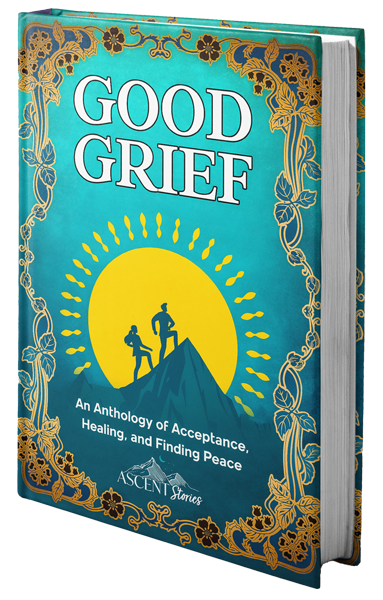
The book stands within a tradition of communal healing literature, echoing the cultural lineage of anthologies that gather lived experience into shared reflection spaces. Like earlier narrative collections that centre human testimony, this work operates as a cultural hearth where readers can encounter versions of themselves across pages.
What distinguishes this anthology is its refusal to treat resilience as sudden triumph.
Resilience in this work is portrayed as geological rather than theatrical. It forms slowly, layer by layer, under the pressure of lived experience.
The guiding philosophy of the book can be summarized as follows:
Grief is not an enemy of meaning.
Grief is the soil where meaning sometimes chooses to grow.
The anthology’s emotional architecture rests on the realization that healing is not the absence of sadness but the integration of memory into continued living.
The narrative voice of the project reflects a shift from survival storytelling toward what might be called post-grief consciousness. This is the state in which loss is acknowledged without allowing it to define the horizon of identity.
Readers are invited not to escape pain but to walk beside it until it softens its edges.
In cultural terms, the book contributes to the tradition of collective testimony literature. Like community story circles, the anthology transforms individual suffering into shared humanity, allowing private experience to enter public compassion without sensationalism.
The work carries an ethical sensitivity toward emotional representation. It resists romanticizing suffering while affirming that human vulnerability is neither weakness nor failure. Instead, vulnerability becomes a doorway through which authenticity enters.
The title itself functions as philosophical compression.
“Good” and “grief” are not placed in opposition but in conversation. The work suggests that grief, when held consciously, can become a teacher of empathy, patience, and interior strength.
II. Turning Pain into Cultural Future
Calgary Creative Industry Outlook Editorial
The publication of Good Grief also represents a broader moment within the evolving Canadian storytelling landscape.
Calgary’s creative economy is entering a period of narrative self-definition.
As the region continues to develop its media, film, and cultural production infrastructure, there is increasing recognition that emotional storytelling is as economically relevant as technical production capability.
The future of Alberta’s cultural industry will likely be shaped by three interlocking movements.
First, community-centered storytelling will expand.
Audiences are demonstrating stronger interest in narratives that reflect lived regional experience rather than purely external cultural models. Works like this anthology contribute to building a local intellectual and emotional vocabulary.
Second, hybrid media publishing will become more important.
The boundary between book, film, and digital narrative is dissolving. Successful cultural projects will increasingly operate across multiple platforms, allowing stories to travel between physical publication, screen adaptation potential, and community conversation spaces.
Anthologies such as this one demonstrate the viability of emotionally grounded literary media within modern attention economies.
Third, resilience narrative literature will continue to grow.
Societies are entering an era where psychological honesty is valued alongside technical achievement. Cultural products that address emotional complexity without simplifying human experience are likely to find sustained relevance.
From an industry perspective, projects like Good Grief also represent the maturation of Canadian independent publishing ecosystems.
Independent literary production contributes to cultural sovereignty by ensuring that regional voices maintain creative autonomy while participating in global dialogue.
Closing Reflection
This book is not about finishing grief.
It is about learning how to live beside it with dignity.
The work speaks quietly but firmly to a future where emotional honesty is considered cultural strength rather than vulnerability.
If cinema teaches us how to see, literature teaches us how to feel, and community storytelling teaches us how to remember together.
Good Grief stands as an invitation to transform sorrow into presence, and presence into purpose.
The legacy of the work is not measured in the disappearance of pain, but in the emergence of meaning.